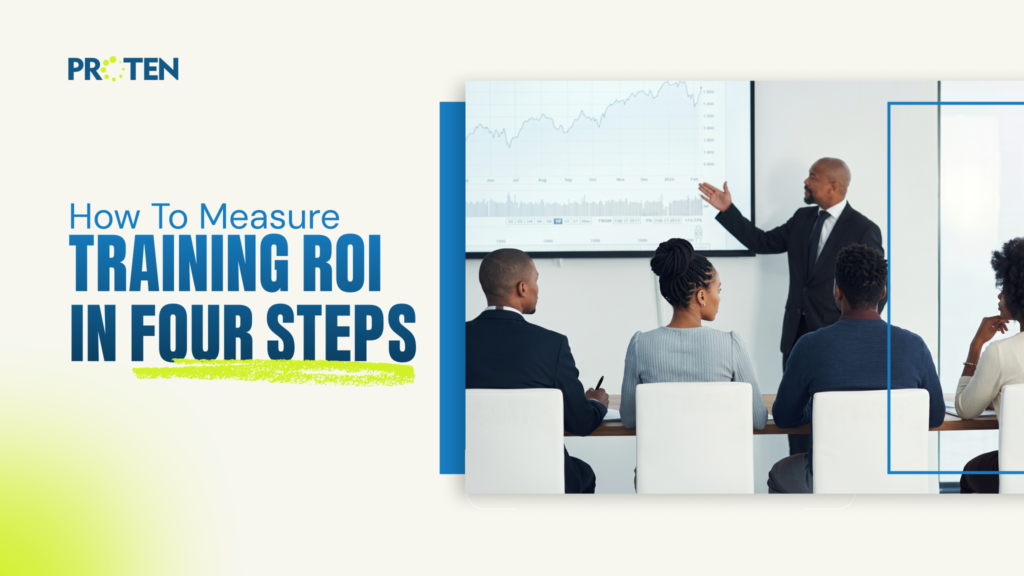
If your company spends millions of naira on employee training, can you show what the business gained from that investment?
Training attendance, completion rates, and positive feedback are useful indicators, but they do not tell the whole story. What matters is whether employees apply what they learn and whether that translates into better performance.
Measuring training return on investment (ROI) helps businesses understand the value of their learning and development programmes, identify what works and make better decisions about future training budgets.
Here are four steps to help you measure training ROI.
What Is Training ROI?

Training return on investment (ROI) measures the financial benefits a business gains from a training programme compared with the cost of delivering it.
For example, if a sales training programme helps employees improve conversion rates and generate additional revenue, the business can compare the value of those gains with the cost of the programme.
The standard formula is:
Training ROI (%) = [(Financial benefits − Total training costs) ÷ Total training costs] × 100
A positive ROI means the estimated financial benefits exceeded the training costs. A negative ROI means the costs were higher than the measured financial benefits.
However, not every training outcome can be measured directly in monetary terms. Improvements in employee confidence, teamwork, leadership, and engagement may also be valuable, even when assigning them a financial value is difficult.
The goal is to select measures that reflect what the business wants the training to achieve.
How to Measure Training ROI in Four Steps

Step 1: Define the Business Goals
Before organising a training programme, identify the business problem it is expected to solve.
A company may want to improve customer satisfaction, reduce operational errors, increase sales, strengthen leadership or help employees use a new system more effectively. Each objective requires a different way of measuring success.
For example, if a customer service team receives training to improve complaint resolution, relevant measures could include average resolution time, customer satisfaction scores, and the number of complaints escalated.
Establish a baseline using existing performance data. This gives you a reference point for comparing results after the training.
Ask these questions before the programme begins:
- What business problem are we trying to solve?
- Which employees need the training?
- What should participants be able to do differently afterwards?
- Which performance indicators will show improvement?
- When should we expect to see results?
The Chartered Institute of Personnel and Development (CIPD) recommends linking learning evaluation to identified performance gaps and organisational objectives. This makes it easier to assess whether a programme addresses a real business need. Read CIPD’s guidance on learning evaluation.
Step 2: Measure What Employees Learn and Apply
Completing a training programme does not automatically mean employees have acquired the skills they need. Even when learning takes place, employees may struggle to apply it in their daily work.
You therefore need to assess two things: what participants learned and whether their behaviour or performance changed afterwards.
Depending on the training objectives, you can use:
- Pre- and post-training assessments: Compare participants’ knowledge or skill levels before and after the programme.
- Practical exercises: Ask employees to demonstrate a skill through a simulation, case study or work-related task.
- Manager feedback: Ask supervisors whether employees are applying the skills on the job.
- Follow-up evaluations: Check progress several weeks or months after training.


For example, after a leadership programme, managers could be assessed on how effectively they delegate tasks, give feedback and handle team conflicts. Their supervisors could then review whether these behaviours improve over time.
It is also important to create opportunities for employees to practise what they have learned. Manager support, coaching and clear expectations can help turn training into lasting workplace improvements.
Step 3: Track Business Results
Once employees have had time to apply their new skills, compare business performance against the baseline established before training.
The right metrics depend on the programme.
| Training programme | Possible measures of business impact |
| Sales training | Conversion rates, revenue per salesperson, average deal value |
| Customer service training | Customer satisfaction, complaint resolution time, repeat complaints |
| Leadership training | Team productivity, employee turnover, performance review outcomes |
| Technical training | Error rates, output quality, time spent completing tasks |
| Compliance training | Policy violations, audit findings, reporting accuracy |
Review the results over an appropriate period. Some improvements may appear within weeks, while leadership development or changes in employee retention may take several months to assess.
Be careful when attributing improvements to training alone. New technology, changes in demand, management decisions and other business initiatives may also influence performance.
Where possible, compare results across similar teams or periods and document other factors that could have contributed to the outcome.
This gives you a more credible assessment of training’s contribution to business performance.
Step 4: Calculate the Training ROI
Once you have identified measurable financial benefits and gathered the relevant cost data, you can calculate training ROI.
First, determine the total cost of the programme. Include more than the trainer’s fee. Depending on the programme, costs may include:
- Training materials and learning platforms
- Venue, logistics and facilitator expenses
- Employee time spent attending training
- Travel and accommodation
- Assessment and follow-up activities
- Internal administration and programme development
Next, estimate the financial value of the benefits. These could include additional revenue, reduced operating costs, fewer errors or lower costs associated with avoidable employee turnover.
Use a consistent measurement period and avoid counting the same benefit twice.
Example: Calculating training ROI
Imagine a company invests ₦2 million in a sales training programme. After reviewing its performance data, it estimates that the programme contributed ₦3 million in additional financial benefits.
The calculation would be:
ROI = [(₦3,000,000 − ₦2,000,000) ÷ ₦2,000,000] × 100
Training ROI = 50%
This means the estimated net financial return was ₦1 million, equivalent to 50% of the training investment.
This is an illustrative example, not a guarantee of the results a training programme will deliver. The reliability of the calculation depends on the quality of the data and how accurately the business estimates the benefits attributable to training.
If the financial benefits cannot be measured reliably, report the non-financial outcomes separately rather than assigning them an arbitrary monetary value.
Common Mistakes to Avoid When Measuring Training ROI

Even with a clear process, some mistakes can make training evaluations less useful.
1. Measuring attendance instead of impact
Attendance and completion rates show participation. They do not prove that employees learned new skills or improved their performance.
2. Setting objectives after training
Without clear goals and baseline data, it becomes difficult to determine whether the programme made a difference. Decide what success looks like before training begins.
3. Ignoring indirect costs
Calculating ROI using only facilitator fees may overstate the financial return. Include relevant employee time, administration and follow-up expenses.
4. Measuring results too early
Some skills require time and workplace practice before their effects become visible. Set a follow-up period that reflects the training objectives.
5. Assuming every improvement came from training
Business performance is influenced by several factors. A sound evaluation considers other possible explanations before attributing results to a learning initiative.
How Proten Supports Measurable Learning and Development
Measuring training ROI starts with selecting the right training for the right business need.
At Proten International, our Learning and Development solutions are designed to help organisations address workforce capability gaps through practical, tailored training programmes. We work with businesses to identify development needs and build employee skills that support performance and organisational growth.
Whether your organisation wants to strengthen leadership, improve sales performance, develop its HR team or build operational capability, the starting point is understanding what your people need to do better.
Explore Proten’s corporate training and Learning & Development solutions to see how a tailored programme can support your business goals.
Final Thoughts
Training ROI is about understanding whether your investment in employee development is contributing to the results your business needs.
Define clear objectives, assess learning, track workplace performance and calculate the financial return where reliable data is available. Together, these steps help HR and L&D teams demonstrate value, improve future programmes and make better-informed budget decisions.
Ready to identify your team’s training needs? Book a training needs call with Proten International to discuss a learning and development programme aligned with your business goals.