Hiring the wrong employee costs more than money. It reduces momentum.
Every new hire shapes your organization’s productivity, culture, customer experience, and long-term growth. Yet many businesses, especially startups and SMEs, approach recruitment as a race to fill vacancies instead of an opportunity to strengthen their workforce.
A rushed hiring decision can lead to poor performance, low morale, higher turnover, and repeated recruitment costs. In many cases, the real issue isn’t a shortage of talent, it’s the absence of a structured hiring process.
Today’s labour market is more competitive than ever. Skilled professionals have more choices, hiring timelines are getting longer for specialised roles, and businesses are expected to evaluate not only technical competence but also adaptability, learning agility, and cultural alignment. Against this backdrop, relying on instinct alone is no longer enough.
Whether you’re hiring your first employee, expanding your team, or replacing a critical role, your hiring decisions should support your business strategy, not just solve an immediate staffing need.
In this guide, you’ll learn:
- Why businesses make costly hiring mistakes.
- An eight-step framework for hiring the right employees.
- Practical recruitment best practices you can implement immediately.
- The metrics every business should track after hiring.
- Common hiring pitfalls to avoid.
- How HR advisory support can help you build a stronger recruitment process.
You’ll also be able to download a Hiring Checklist & Recruitment Planning Template to help you put these principles into practice.
Why Hiring the Right Employees Matters

Hiring is one of the few business decisions that affects nearly every aspect of organisational performance.
A strong hire can improve team collaboration, increase productivity, strengthen customer relationships, and contribute fresh ideas. On the other hand, a poor hire can consume management time, reduce employee morale, and create unnecessary financial costs.
Research consistently highlights the impact of effective hiring:
- Gallup has reported that managers account for a significant portion of the variance in team engagement, making hiring decisions for leadership roles especially critical.
- LinkedIn’s Global Talent Trends continues to show that skills, adaptability, and learning potential are becoming increasingly important alongside experience.
- Deloitte’s Global Human Capital Trends emphasizes that organisations creating sustainable value are investing in skills-based talent strategies rather than relying solely on traditional qualifications.
For growing businesses, every recruitment decision represents an investment. The objective isn’t simply to recruit someone who can perform today’s tasks but to hire individuals who can contribute to the organisation’s future.
Proten Insight
Hiring should never begin with a vacancy. It should begin with a business objective. The best recruitment decisions are driven by strategy, not urgency.
Why Many Businesses Get Hiring Wrong

Most hiring challenges don’t start during interviews.
They begin long before a vacancy is advertised.
Through our work with organizations across industries, including manufacturing, financial services, healthcare, technology, retail, NGOs, and oil and gas, we’ve observed that many recruitment problems stem from weaknesses in planning rather than candidate availability.
Here are some of the most common mistakes businesses make.
i. Hiring Reactively Instead of Strategically
One employee resigns.
A replacement is needed immediately.
The business rushes to advertise the role without asking important questions:
- Do we still need this position?
- Has the role evolved?
- Could responsibilities be redistributed?
- Should we recruit different skills instead?
Recruiting without evaluating the business need often results in hiring someone who fills a seat rather than solves a problem.
ii. Poorly Defined Job Roles
One of the biggest recruitment mistakes businesses make is assuming candidates understand what success looks like.
A vague job description usually leads to:
- unsuitable applications
- inconsistent interview questions
- mismatched expectations
- poor performance after hiring
An effective job description should clearly define:
- purpose of the role
- key responsibilities
- reporting relationships
- required competencies
- performance expectations
- success measures
Without this clarity, even highly qualified candidates may struggle.
iii. Prioritising Speed Over Quality
Many SMEs operate with lean teams, making every vacancy feel urgent.
However, hiring the wrong person quickly is often more expensive than waiting to hire the right person.
Recruitment should balance efficiency with diligence.
That means allocating enough time to:
- screen applications
- assess competencies
- conduct structured interviews
- verify credentials
- evaluate cultural fit
iv. Making Decisions Based on Instinct Alone
“She seemed confident.”
“He reminded me of someone successful.”
“I just had a good feeling.”
While experience and intuition have value, relying solely on instinct introduces unconscious bias into recruitment.
Structured interviews, competency scorecards, and objective assessment methods create more consistent and defensible hiring decisions.
v. Skipping Background Verification
Many organisations perform interviews but neglect verification.
Reference checks, employment verification, educational verification, and identity confirmation provide additional confidence before making an offer.
For positions involving finance, leadership, compliance, or customer trust, background verification should be an essential part of the recruitment process—not an afterthought.
Common Hiring Mistake
Assuming a strong interview guarantees future performance. Interviews reveal potential, but verification helps confirm past experience and reduce hiring risks.
The Hidden Cost of a Poor Hiring Decision

Most businesses calculate recruitment costs by looking at advertising expenses or recruiter fees.
In reality, the cost of a poor hire extends far beyond recruitment.
It can include:
- lost productivity
- repeated recruitment expenses
- onboarding costs
- management time
- customer dissatisfaction
- reduced team morale
- delayed projects
- overtime for other employees
- increased employee turnover
For SMEs and growing businesses with limited resources, these hidden costs can significantly affect profitability and business performance.
This is why leading organisations treat recruitment as a strategic investment rather than an administrative process.
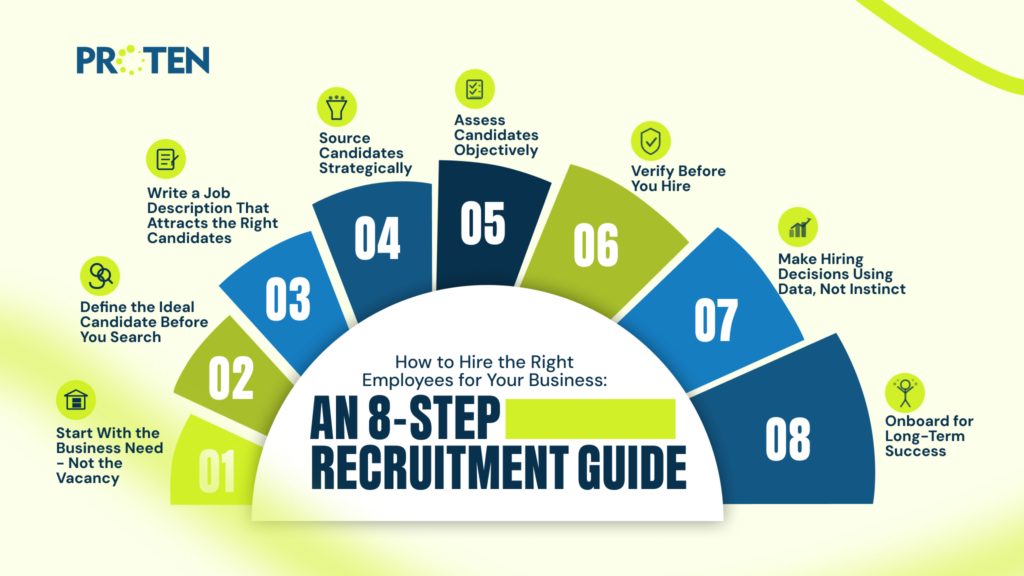
The Proten Hiring Framework

At Proten International, we encourage businesses to approach recruitment through a structured decision-making framework.
Rather than recruiting because a vacancy exists, we recommend following eight deliberate steps that align hiring decisions with business objectives.
Let’s begin with the first step.
Step 1: Start With the Business Need – Not the Vacancy
Before posting a job advertisement, ask one important question:
What business problem are we trying to solve?
This simple question changes the entire recruitment process.
Instead of focusing on replacing an employee, focus on understanding the capability your organisation actually needs.
For example:
Rather than saying:
“We need another Sales Executive.”
Ask:
- Are sales targets being missed?
- Are customers underserved?
- Has the business expanded into a new market?
- Do we need stronger relationship management skills?
- Is workload exceeding current capacity?
The answers help determine whether you need another employee, or perhaps a different role entirely.
This approach is commonly referred to as workforce planning, and it is one of the most overlooked stages of recruitment.
When organisations invest time in workforce planning, they are better positioned to hire people who contribute to long-term business success instead of simply filling immediate gaps.
Questions to Ask Before Recruiting
Before approving any vacancy, consider:
- Why does this role exist?
- What outcomes should this person achieve?
- What skills are genuinely required?
- Could technology or process improvements solve the problem?
- Will this role still be necessary in two years?
- How will success be measured after hiring?
Businesses that answer these questions before recruitment often make stronger hiring decisions.
Proten Insight
The recruitment process should begin with strategy—not sourcing. Workforce planning helps businesses avoid unnecessary recruitment, reduce hiring costs, and identify the capabilities needed for future growth.
Step 2: Define the Ideal Candidate Before You Search
One of the biggest reasons businesses struggle to hire the right employee is because they start searching before they know exactly who they need.
Imagine asking a recruiter to “find a good accountant.” That instruction leaves too much open to interpretation.
Should the candidate have experience in manufacturing? Are they expected to manage payroll? Will they supervise a team? Is ERP software experience essential? Do they need strong stakeholder management skills?
Without answering these questions first, even the best recruitment process can produce disappointing results.
Instead of focusing only on qualifications, define the competencies that drive success in the role.
For example:
Technical competencies
- Financial reporting
- Data analysis
- CRM proficiency
- Project management
Behavioural competencies
- Problem solving
- Communication
- Adaptability
- Accountability
- Attention to detail
This approach is known as competency mapping, and it helps ensure every candidate is assessed against the same criteria.
Proten Insight
Skills may get a candidate through the interview, but competencies determine whether they succeed in the role.
According to Deloitte’s 2025 Global Human Capital Trends report, 66% of managers and executives say recent hires are not fully prepared for their roles, with lack of experience cited as the most common gap. This reinforces the point that businesses should look beyond job titles and focus on the capabilities required for success.
Step 3: Write a Job Description That Attracts the Right Candidates
Your job description is your first opportunity to attract the right talent and discourage unsuitable applicants.
Unfortunately, many organisations advertise roles using generic descriptions copied from the internet.
For example:
“We are looking for a hardworking Marketing Executive.”
Hardworking according to whom?
What does success look like?
What will the employee achieve in the first six months?
A stronger description might read:
“We are seeking a Marketing Executive who will increase qualified leads through digital campaigns, coordinate brand communications, and support business growth through data-driven marketing initiatives.”
Notice the difference.
The second description tells candidates exactly what success looks like.
An effective job description should include:
- Job purpose
- Key responsibilities
- Reporting structure
- Required qualifications
- Required competencies
- Performance indicators
- Working arrangement
- Growth opportunities
Candidates are increasingly evaluating employers just as employers evaluate candidates.
A clear job description demonstrates professionalism and helps attract applicants who understand your expectations.
Step 4: Source Candidates Strategically
Finding great employees is about reaching the right talent through the right channels.
Many SMEs rely on one recruitment source, such as employee referrals or a single job board.
While referrals can be valuable, they should not become your only strategy.
Diversifying your sourcing channels increases the likelihood of finding candidates with different experiences and perspectives.
Some effective sourcing channels include:
- Proten Connect
- Employee referrals
- Company careers pages
- Professional associations
- Graduate recruitment programmes
- Recruitment partners
- Industry events
- Talent communities
The right sourcing strategy depends on the role.
For example:
A graduate trainee programme may be ideal for entry-level positions.
An executive leadership role may require targeted executive search rather than public advertising.
Common Mistake
Posting a vacancy everywhere without understanding where your ideal candidates spend their time.
When businesses struggle to attract qualified applicants despite extensive advertising, it often indicates that the recruitment strategy, employer value proposition, or job requirements need review.
This is where an HR advisory partner can help design a recruitment strategy that aligns with your workforce needs rather than relying on trial and error.


Step 5: Assess Candidates Objectively
Interviews remain one of the most widely used hiring tools.
Unfortunately, they are also one of the most inconsistent.
Imagine interviewing five candidates and asking each person different questions.
How do you compare them fairly?
Structured interviews solve this problem.
They ensure every candidate is evaluated against the same competencies using consistent questions and scoring criteria.
For example, if “problem solving” is an essential competency, every shortlisted candidate should be asked a behavioural question such as:
“Tell us about a time you solved a difficult problem under pressure. What was the outcome?”
Instead of relying on memory after the interview, use a scorecard to rate each response.
Assessment methods may include:
- Structured interviews
- Technical assessments
- Case studies
- Work sample exercises
- Psychometric assessments
- Presentation tasks
The objective is not to identify the most impressive interviewee.
It is to identify the candidate most likely to perform successfully in the role.
Quote
“Hire for capability and potential, not just confidence.”
Step 6: Verify Before You Hire
A successful interview should not be the final step in your recruitment process.
Verification protects your organisation from avoidable hiring risks.
Depending on the role, verification may include:
- Identity verification
- Employment history
- Educational qualifications
- Professional certifications
- Reference checks
- Criminal record checks where legally appropriate
This step has become increasingly important.
As digital recruitment grows, so do concerns about inaccurate CVs and AI-assisted résumé embellishment. Deloitte’s 2026 Human Capital Trends research found that executives are increasingly concerned about the accuracy and trustworthiness of candidate data, particularly as AI makes it easier to exaggerate skills and experience.
Likewise, LinkedIn reports that professionals are placing greater importance on verification and employer authenticity as job-related scams become more common.
Verification is not about distrust.
It is about reducing risk and making informed hiring decisions.
For organisations hiring into finance, procurement, compliance, or leadership positions, background verification should be considered an essential part of good governance.
Step 7: Make Hiring Decisions Using Data, Not Instinct
After screening applications, conducting interviews, and verifying credentials, many businesses still make one critical mistake.
They choose the candidate they “like” the most.
While intuition has a place in decision-making, it should never outweigh evidence.
A structured hiring process helps reduce bias by comparing candidates against the same criteria.
One of the simplest ways to achieve this is by using a candidate evaluation scorecard.
For example:
| Competency | Weight | Candidate A | Candidate B |
| Technical Skills | 30% | 26 | 22 |
| Problem Solving | 20% | 18 | 16 |
| Communication | 15% | 12 | 14 |
| Culture Fit | 20% | 17 | 15 |
| Learning Agility | 15% | 13 | 12 |
Rather than debating opinions after interviews, hiring managers can compare evidence.
This approach is especially valuable when multiple interviewers are involved.
Proten Insight
Every hiring decision should be explainable. If you cannot clearly explain why Candidate A was selected over Candidate B, your hiring process needs more structure.
Many organisations also involve HR and line managers in the final decision to balance technical expertise with organisational fit.
For senior or business-critical roles, consider holding a final hiring review meeting to discuss:
- Assessment results
- Interview feedback
- Reference checks
- Verification outcomes
- Salary alignment
- Potential development needs
This reduces the likelihood of making emotional or rushed hiring decisions.
Step 8: Onboard for Long-Term Success
Hiring does not end when the offer letter is signed.
In fact, that is where employee success begins.
A great recruitment process can still fail if new employees are left to “figure things out” during their first few weeks.
Effective onboarding helps employees understand:
- Their role and responsibilities
- Company values and culture
- Performance expectations
- Team structures
- Internal processes
- Available tools and resources
It also helps new hires build relationships and become productive more quickly.
According to Gallup, employees who experience exceptional onboarding are significantly more likely to feel prepared, engaged, and supported in their roles. Yet Gallup has also found that only a small proportion of employees strongly agree that their organisation does an excellent job of onboarding new staff. This highlights a major opportunity for employers to improve retention from day one.
A simple onboarding plan could include:
Before Day One
- Send the offer letter and employment documents.
- Prepare the employee’s workstation and system access.
- Share a welcome email and first-week agenda.
Week One
- Introduce the employee to key stakeholders.
- Explain performance expectations.
- Complete mandatory training.
- Assign a buddy or mentor.
First 90 Days
- Hold regular check-ins.
- Review performance against agreed goals.
- Gather feedback from both the employee and manager.
Common Mistake
Assuming that orientation is the same as onboarding. Orientation may last a day. Effective onboarding can continue for several months.
Businesses that invest in structured onboarding often see improvements in employee engagement, productivity, and retention.


How to Measure Hiring Success

Many organisations stop measuring once a candidate accepts an offer.
However, successful hiring should be evaluated long after recruitment ends.
Tracking the right metrics helps businesses identify what is working and where improvements are needed.
Here are some key recruitment metrics to monitor:
1. Time to Hire
How long does it take to move from vacancy approval to offer acceptance?
A lengthy hiring process can increase costs and cause businesses to lose strong candidates.
2. Cost per Hire
This includes advertising, recruiter fees, assessment costs, interview expenses, onboarding, and other recruitment-related costs.
Understanding this figure helps organisations plan recruitment budgets more effectively.
3. Quality of Hire
Did the employee meet performance expectations?
Are they adding value to the business?
Quality of hire can be measured using performance reviews, manager feedback, and productivity indicators.
4. First-Year Retention
If employees consistently leave within the first year, it may indicate problems with recruitment, onboarding, or organisational culture.
5. Hiring Manager Satisfaction
Ask hiring managers:
- Did the employee meet expectations?
- Was the recruitment process efficient?
- Would you hire this person again?
6. Employee Engagement
Engaged employees are generally more productive and more likely to remain with the organisation.
Regular engagement surveys can reveal whether new hires feel connected to the organisation and supported in their roles.
Proten Insight
Recruitment success is not measured by how quickly a vacancy is filled. It is measured by how well the employee performs and grows after joining the organisation.
Common Hiring Mistakes to Avoid

Even organisations with established recruitment processes can fall into avoidable traps.
Before making your next hiring decision, ask yourself whether any of these mistakes sound familiar.
- Hiring because the team is under pressure.
- Copying a generic job description from the internet.
- Prioritising experience over competencies.
- Conducting unstructured interviews.
- Relying on instinct instead of evidence.
- Skipping reference or background checks.
- Making an offer without a structured onboarding plan.
If you answered “yes” to any of these, your hiring process may benefit from review.
When Should You Engage an HR Advisory Partner?

Not every organisation has an internal HR team.
Even those that do may need external expertise during periods of growth or change.
An HR advisory partner can help when:
- You are hiring your first employee.
- Your business is scaling rapidly.
- Employee turnover is increasing.
- Recruitment is taking too long.
- You need to redesign your hiring process.
- You want to improve workforce planning.
- You are expanding into new markets or business units.
At Proten International, our HR Advisory team works with organisations to design recruitment frameworks, strengthen hiring processes, and build workforces that support sustainable growth.
Our services include:
- HR Advisory
- Recruitment and Selection
- Employee Outsourcing
- Payroll Management
- Learning and Development
- Background Verification through 360 Verify
Rather than focusing solely on filling vacancies, we help businesses build recruitment systems that improve hiring quality over time.


Download Your Free Hiring Checklist & Recruitment Planning Template
Recruitment becomes much easier when you have a repeatable process.
To help you get started, we have created a practical resource for business owners, HR professionals, and hiring managers.
The Hiring Checklist & Recruitment Planning Template includes:
- Hiring Needs Assessment
- Job Description Template
- Candidate Evaluation Scorecard
- Interview Evaluation Form
- Recruitment Planning Checklist
Whether you are hiring your first employee or expanding your workforce, this resource will help you make more structured and informed hiring decisions.
Download the free Hiring Checklist & Recruitment Planning Template today.
Frequently Asked Questions

What is the first step in hiring the right employee?
The first step is understanding the business need behind the vacancy. Before advertising a role, identify the problem the employee is expected to solve, the outcomes they should deliver, and the skills required to achieve those outcomes.
How can small businesses improve their hiring process?
Small businesses can improve hiring by creating clear job descriptions, using structured interviews, assessing candidates against defined competencies, conducting background checks, and implementing a structured onboarding programme.
Why are job descriptions important?
A well-written job description helps attract suitable candidates, clarifies expectations, supports objective interviews, and reduces the risk of hiring someone whose skills or experience do not match the role.
Should every business conduct background verification?
Background verification is recommended for most roles and is especially important for positions involving finance, leadership, compliance, customer trust, or access to sensitive information. Verification helps confirm employment history, qualifications, and other credentials before an offer is finalised.
How long should onboarding last?
While orientation may take one day, effective onboarding often extends over the first 30 to 90 days. This allows employees to build confidence, understand expectations, and become fully productive.
Conclusion
Hiring the right employees is not about luck.
It is about building a process that consistently identifies people who can contribute to your organisation’s success.
Businesses that hire well rarely rely on instinct alone. They plan their workforce, define the role clearly, assess candidates objectively, verify credentials, and invest in onboarding.
As your organisation grows, every hiring decision shapes your culture, your customer experience, and your ability to compete.
The businesses that thrive over the long term are not necessarily those that hire the fastest. They are the ones that hire with purpose.
If your organisation is looking to strengthen its hiring process, improve recruitment outcomes, or build a more effective workforce strategy, partnering with an experienced HR advisory team can help you make more confident hiring decisions.