In the modern corporate world, employee retention has shifted from a transactional human resources metric to a critical driver of organisational performance. Employee engagement refers to the extent to which employees are emotionally and psychologically connected to their organisation and motivated to contribute towards its success. Employee disengagement is one of the costliest yet least visible threats facing organisations today, creating operational drag that erodes profitability, stifles innovation and accelerates costly talent attrition.
Employees today have access to global job markets via digital platforms, can benchmark their own compensation in real time, and are acutely aware of the gap between the cultures organisations claim to have and the ones they actually demonstrate. As a result, talent has become mobile, selective, and increasingly difficult to retain without sustained investment in the conditions that make work meaningful.
Identifying Key Engagement Drivers
To build an effective retention strategy, leadership must adopt engagement that is driven by structural, psychological, and developmental factors:
- The Line Manager Competency: The adage “people leave managers, not companies” remains structurally true. A capable manager acts as an engagement anchor; they communicate expectations clearly and consistently; they recognise effort and achievement in real time; they build psychological safety. Employees who trust their managers are four times more likely to be engaged and 58% less likely to actively look for another job.
- Meaningful Learning and Reskilling: Professional stagnation is one of the primary catalysts for employee turnover. 82% of employees report that access to meaningful learning directly impacts their workplace motivation.
- Structured Recognition and Belonging: Recognition directly influences a worker’s willingness to expend discretionary effort. Employees who receive regular, meaningful recognition are 45% less likely to leave within their first two years.
- Work Environment and Autonomy: Workplace friction degrades morale. Employees in hybrid environments report engagement levels that are 6% higher than national averages, whereas those subjected to rigid, mandated office returns score 7% lower.
Organisations that fail to engage their workforces will find themselves locked in an expensive, unsustainable cycle of talent acquisition, struggling against stagnant productivity and leaking profitability.
Engagement as a Core Business Metric
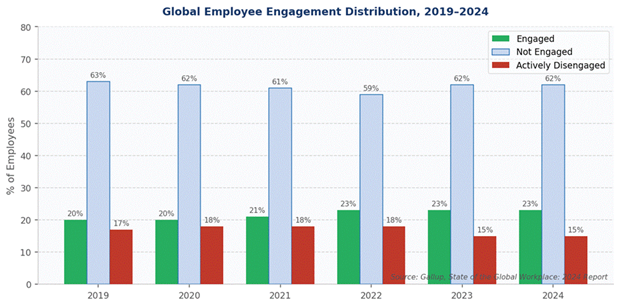
According to global workforce studies, organisations with highly engaged employees consistently outperform their peers across financial and operational metrics. Employees who are emotionally invested in their work demonstrate higher concentration, stronger initiative, and greater efficiency. Business leaders who treat engagement as a strategic priority by investing in manager capability, offering clear developmental pathways, and respecting employee autonomy build cultures that naturally attract and retain premium talent
Key Drivers of Employee Engagement
- Work-Life Balance and Flexibility: The relationship between flexibility and engagement has been transformed by the pandemic and the normalisation of hybrid and remote working. The ability to manage work around life rather than life around work has shifted from a valued benefit to a baseline expectation among significant portions of the global workforce.
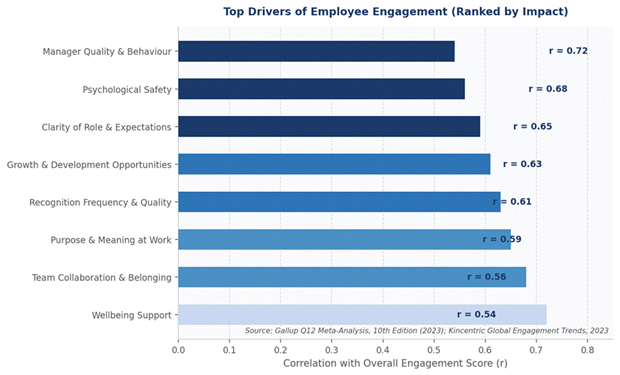
- Quality of Line Management: The direct manager remains the single most influential factor in day-to-day engagement. Research by Gallup across more than 100,000 teams globally finds that manager behaviour accounts for 70% of the variance in team-level engagement scores. What employees need from their managers is not technical brilliance but relational competence: the ability to set clear expectations, listen genuinely, give honest and constructive feedback, recognise effort, advocate for their team, and create an environment of trust.
- Career Growth and Development Opportunities: The opportunity to acquire new skills, expand responsibility, and build a meaningful career. According to LinkedIn’s 2023 Workplace Learning Report, 94% of employees would stay longer with an employer that invested in their development. Organisations that create personalised, accessible, and credible development frameworks hold a significant engagement advantage
- Job Security and Organisational Stability: In a volatile economic environment, uncertainty about role or organisational stability undermines engagement directly. Employees who fear redundancy or organisational dysfunction divert psychological energy away from their work and towards their exit strategy.
- Recognition and Appreciation: Employees who feel their contributions are seen and acknowledged are significantly more likely to invest discretionary effort and remain loyal. Effective recognition is frequent, specific, timely, and personally meaningful. Gallup’s research finds that employees who receive meaningful recognition are five times more likely to be engaged than those who do not.
- Autonomy and Empowerment: Organisations that extend genuine autonomy within clear frameworks of accountability consistently find that employees respond with higher effort, greater creativity, and stronger commitment.
- Fairness, Equity, and Inclusion: Fairness in pay, in promotion, in how decisions are made and communicated, and in how different groups within the workforce are treated. Employees who feel their identity is respected, that bias is actively managed, and that they belong in the organisation they work for bring materially higher levels of engagement than those who feel marginalised or overlooked.

Effects of Disengagement on Business
Employee disengagement is not a passive condition. It is an active drain on every dimension of organisational performance: financial, operational, cultural, and reputational. The following are the most significant business effects of employee disengagement:
- Reduced Productivity: Disengaged employees do the minimum required to avoid consequences. They do not bring discretionary effort, the additional energy, creativity, and commitment that separates adequate performance from outstanding performance.
- Increased Employee Turnover: Disengagement is the most reliable leading indicator of voluntary departure. Gallup’s research consistently finds that actively disengaged employees are 59% more likely to be actively seeking alternative employment than their engaged counterparts.
- Higher Recruitment and Replacement Costs: Departure triggered by disengagement carries a direct financial cost that most organisations systematically underestimate. The full cost of replacing an employee includes management and HR time spent on interviews and selection, onboarding and induction investment, training and ramp-up costs, the reduced output of the role during the vacancy period, and the time required for the replacement to reach the productivity level of the departed individual.
What Employee Engagement Actually Does for Your Business
- Productivity: Engagement changes the quality of how employees work. When someone is genuinely invested in their role, they bring cognitive ownership to it; they think about problems, anticipate issues, and care about outcomes in ways that no performance framework or incentive scheme can manufacture.
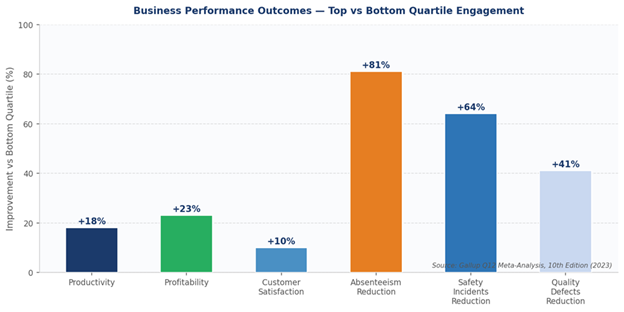
- Profitability: Organisations whose teams sit in the top quartile of engagement measures consistently achieve 23% higher profitability than those in the bottom quartile. Employees are more attentive, more creative in resolving problems, and more willing to go beyond what is strictly required to deliver an experience that generates loyalty, repeat business, and word-of-mouth advocacy.
- Retention: Employees who feel valued, connected, and properly managed are 51% less likely to experience turnover. When engagement is high, the baseline temptation to look for external opportunities evaporates, creating a stable internal talent pool. High engagement does not just reduce turnover; it creates the kind of internal environment in which talent accumulates and deepens over time, rather than cycling through the organisation before it ever reaches its full potential.
How Proten International Can Help
As work continues to evolve, organisations must move beyond superficial engagement initiatives and embed engagement into leadership practices, workplace culture, and business strategy. Are you experiencing low engagement levels within your workforce? At Proten International, we help create resilient, high-performing organisations capable of sustaining growth and retaining top talent in an increasingly competitive labour market. Contact us today to get started.