The traditional view of employees or human capital as a cost centre is increasingly obsolete. All around the world, organisations have realised that their human resources are their most prized assets. Rising productivity, precipitated by the accelerating adoption of technology and automation, has shown the workforce to be the pivotal driver of organisational success.
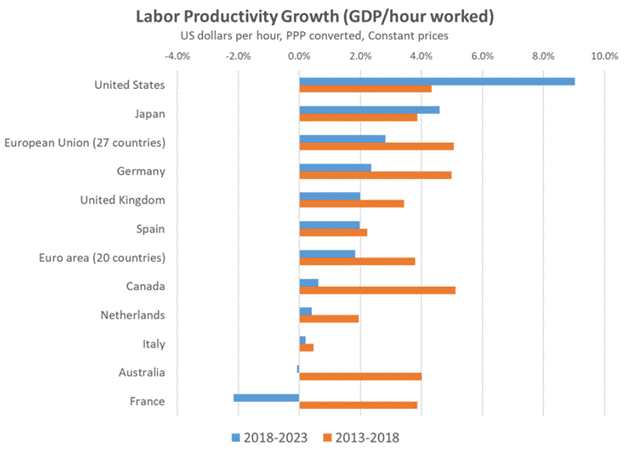
Source: OECD
This shift underscores the need for organisations to engineer an empowered workforce that maximises human capital potential to achieve corporate objectives such as revenue growth, innovation, and operational efficiency. The financial argument is also compelling: organisations that invest in employee development achieve up to 218% higher income per employee and 52% higher productivity.
Human capital (encompassing skills, knowledge, institutional experience, and employee engagement) represents a strategic asset. Organisations that invest in transforming their workforce can transition from reactive talent management to proactive value creation. Through strategic recommendations, this document provides a roadmap for leaders to align workforce strategies with corporate objectives, ensuring resilience and competitive advantage in the evolving landscape of work.
2. Current Challenges in Workforce Management
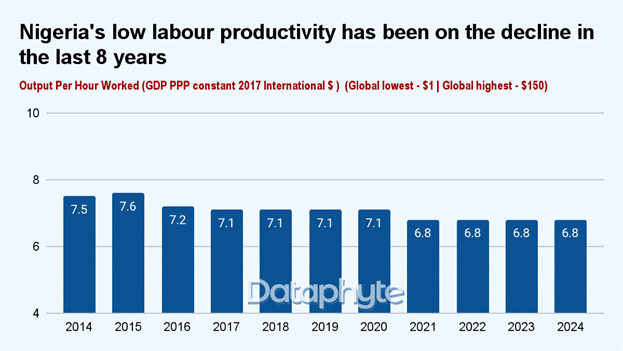
Source: International Labour Organisation
Organisations face multifaceted challenges in managing their workforce effectively. These challenges are not merely operational but existential threats to growth in 2026. Some of these challenges include:
Widening Skills Gaps:
According to WEF, 59% of the global workforce requires upskilling or reskilling by 2030 due to digitisation, robotics, and technological advancements. Talent shortages are exacerbating this, particularly in technical and specialised roles, leading to prolonged vacancies and reduced productivity.
Economic Pressures & Labour Market Tightening:
According to PWC,Unemployment rates are rising in many regions, with Nigeria’s figures projected at 5.3% in 2026, signalling a tightening of the skilled labour market. Economic volatility demands a workforce that can do “more with less,” yet high turnover can cost organisations up to twice an employee’s salary in replacement expenses.
Evolving Employee Expectations:
According to the Bureau of Labour Statistics, 71% of employees now demand flexible schedules and hybrid work environments. This has been a rising trend since the global pandemic shutdown. This evolving expectations require employers to review policies and procedures. Without strategic intervention, organisations risk stagnation and a failure to innovate.
Technological Displacement:
In 2026, the proliferation of technology and automation will intensify, potentially displacing up to 50% of entry-level white-collar jobs. However, this also presents opportunities: organisations that prioritise human capital can turn potential disruptions into growth engines.
3. Benefits of an Empowered Workforce
An empowered workforce yields tangible benefits across efficiency, innovation, and growth. The Return on Investment (ROI) for human capital development is substantial.
Financial Performance:
- Cost Savings: Upskilling and reskilling strategies deliver cost savings of 70–92% compared to the high premiums of external hiring.
- Revenue Growth: Companies emphasising employee development yield 218% higher income per employee. (WEF)
- Profitability: A recent report shared by CNBC shows that organisations with robust learning cultures experience 17% greater profitability.
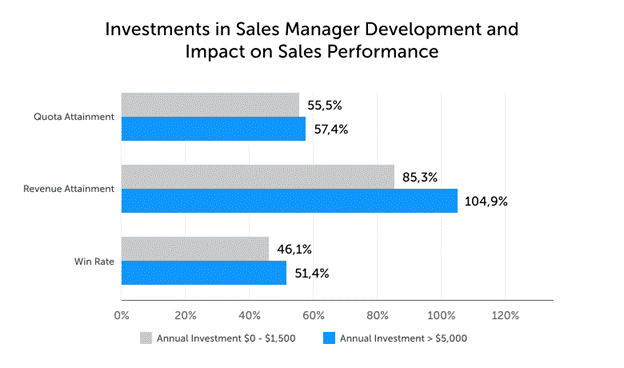
Source: PleinAire
Productivity & Innovation:
- Higher Output: Empowered workforces drive 52% higher productivity.
- Innovation: These organisations report 92% more innovation, as skilled employees are better equipped to experiment and implement new ideas. (CNBC)
- Adaptability: According to a report by the World Economic Forum, upskilling fosters adaptability, with 65% of employees reporting an enhanced ability to handle new technologies.
Retention & Engagement:
- Loyalty: In a 2024 research by Senior Fellows at the Centre on Regulation and Markets, it was shown that 76% of employees are more likely to stay with an employer that offers continuous training opportunities, drastically reducing turnover costs.
- Agility: In industries exposed to advanced technology, productivity growth has increased significantly. By 2030, technology and automation could unlock $15.7 trillion in global economic value through human-technology partnerships. (PwC)
4. Key Initiatives: Upskilling and Reskilling
Upskilling enhances current skills for role advancement, while reskilling equips employees for new positions. Both are essential for 2026, where 50% of workers may need skill renewal.
Strategic Alignment:
- Vision First: Effective implementation begins with clearly defining the organisation’s vision and goals.
- Skill Gap Analysis: Leaders must ascertain specific employee capabilities required to achieve corporate objectives. This necessitates assessing current workforce competencies against future needs through tools like skills inventories, performance data, and predictive analytics.
Targeted Interventions:
- Technology-Powered Learning: Insights from a Wharton School business journal show that 80% of tech leaders cite technology-powered platforms for personalised learning as the top method to close skills gaps.
- Internal Talent Marketplaces: These platforms facilitate mobility, allowing employees to apply for projects or roles internally, reducing hiring needs.
- Micro-Credentials: Deploying short, focused certifications and on-the-job training allows for rapid skill acquisition post-gap analysis.
Integration with Automation:
- Redefining Value: By 2026, automation tools are expected to redefine and exponentially increase value creation.
- Human Oversight: Reskilling employees for oversight roles ensures humans focus on creativity and strategy, yielding 20–40% productivity gains through enhanced output. (Wharton)
5. Other Transformational Initiatives
Beyond upskilling, a range of transformational initiatives can drive workforce output and business growth.
Cultivating a Continuous Learning Culture:
94% of leaders expect employees to acquire new skills on the job. According to data from the National Bureau of Statistics, initiatives like internal digital academies boost throughput by 20–40%, enabling employees to adapt swiftly to emerging technologies.
Internal Mobility Programmes:
Clear career pathways within organisations reduce attrition and foster knowledge transfer across functions. This enhances cross-functional collaboration, leading to innovative solutions and accelerated project delivery.
Diversity, Inclusion, & Leadership:
Harnessing varied perspectives results in teams that are 35% more likely to outperform peers, making this ability a valuable leadership skill. Development initiatives should be introduced that can build managers capable of guiding teams through change, improving decision-making and strategic execution.
Performance & Wellbeing:
Performance management systems integrated with real-time feedback tools align individual contributions with organisational goals. 71% of workers prioritise flexible schedules, which links to 147% higher earnings per share in engaged organisations. (Forbes)
Support programmes reduce burnout, sustaining long-term productivity and innovation.
6. Driving Profit and Growth in 2026
As organisations look toward 2026, the real productivity advantage will not come from technology alone, but from the clarity, capability, and accountability built into their workforce strategies. High-performing organisations will be those that deliberately invest in their people—through targeted upskilling, clear performance expectations, and operating models that empower employees to deliver value consistently.
Workforce productivity in the coming year will be shaped by practical organisational initiatives: redefining roles around critical skills, embedding performance management systems that reward outcomes rather than activity, and strengthening onboarding and continuous learning frameworks that shorten time-to-impact for new and existing talent. These actions, more than any single tool or platform, will determine whether human capital remains a cost centre or evolves into a measurable driver of growth.
How Proten International Can Help
Proten International supports organisations seeking to convert workforce capability into measurable profit and sustainable growth. Our approach recognises that growth is not driven by headcount expansion alone, but by how effectively skills, roles, and performance are aligned to business strategy.
Through our Learning and Development services, we help organisations conduct structured skills gap analyses to identify where current capabilities fall short of strategic and commercial objectives. This insight informs targeted upskilling and reskilling programmes designed to strengthen critical competencies and accelerate talent readiness for future roles.
Complementing this, our HR Advisory services support organisations with strategic workforce planning and transformation. We work with leadership teams to redesign roles around value creation, align workforce structures to growth priorities, and embed performance frameworks that link individual output to business results.
Together, Proten’s Learning and Development and HR Advisory offerings enable organisations to move beyond reactive people management toward deliberate workforce strategies that drive margin improvement, business resilience, and long-term growth. Contact us via info@protenintl.com to get started.