Performance evaluation is meant to drive accountability, guide development, and align individual effort with organisational goals. Many organisations find that their review system does the opposite: it consumes management time, generates dissatisfaction, and produces little change in actual behaviour or output. Performance evaluations directly shape some of the most consequential decisions an organisation makes: who gets promoted, where learning and development budget is spent, who is placed on the succession pipeline, how compensation is allocated, and how engaged employees feel on a day-to-day basis.
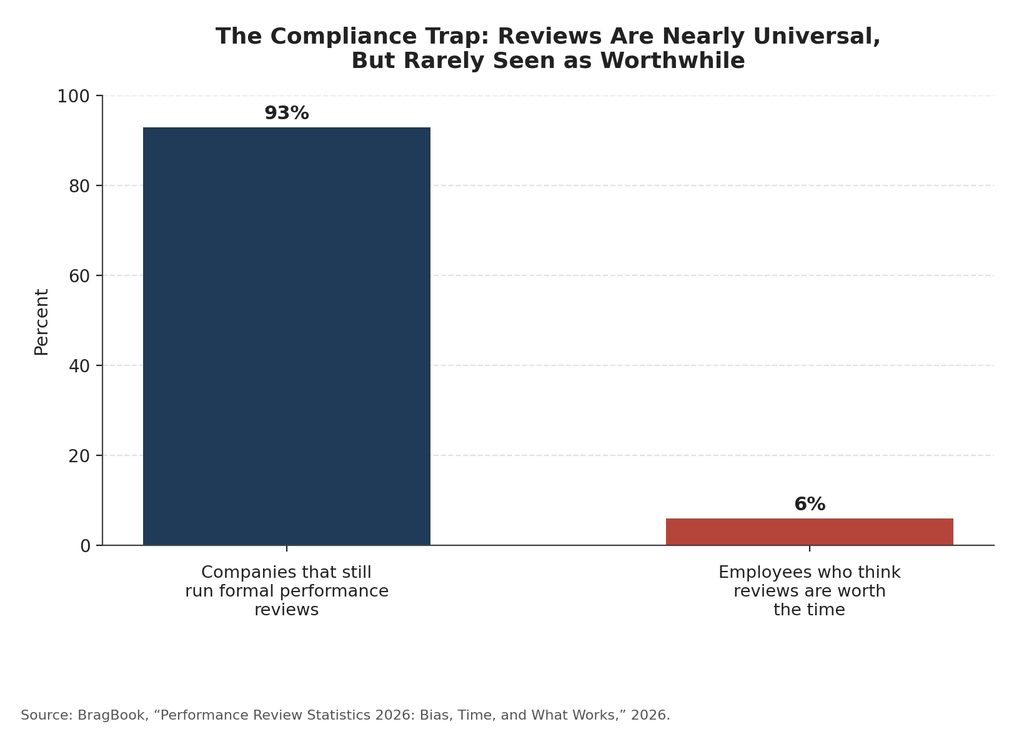
Source: BragBook, “Performance Review Statistics 2026:
Scenario One:
The Compliance Exercise
In this scenario, performance reviews are reduced to a routine administrative task, completed primarily to satisfy organisational or policy requirements rather than to genuinely assess or develop people. Managers assign generic ratings with little supporting evidence and minimal substantive discussion. The review becomes something to be “gotten through” by both parties, rather than a meaningful exchange. Organisations often display recognisable warning signs: review forms completed in a matter of minutes, ratings that cluster heavily around “meets expectations” regardless of actual performance variation, employees who cannot recall specific feedback from their last review, and managers who treat the exercise as a box to tick before a compensation cycle rather than an ongoing management responsibility.
Productivity Consequences
- Limited employee development: Employees receive little meaningful feedback on their strengths, weaknesses, or areas for improvement, leaving them without a clear understanding of how to grow and perform better.
- Reduced managerial credibility: Managers lose credibility as evaluators and coaches because employees begin to see performance reviews as a compliance exercise rather than an honest assessment of their work and contribution.
- High performers feel undervalued: Strong contributors may feel overlooked when generic ratings fail to distinguish exceptional performance from average performance, potentially reducing motivation and increasing the risk of losing valuable talent.
Strategic Intervention Plan
- Managers need to be trained in objective, evidence-based performance coaching, rather than being left to assume that rating ability is intuitive.
- Shift from an annual review event to continuous performance conversations, so that feedback is timely enough to change behaviour.
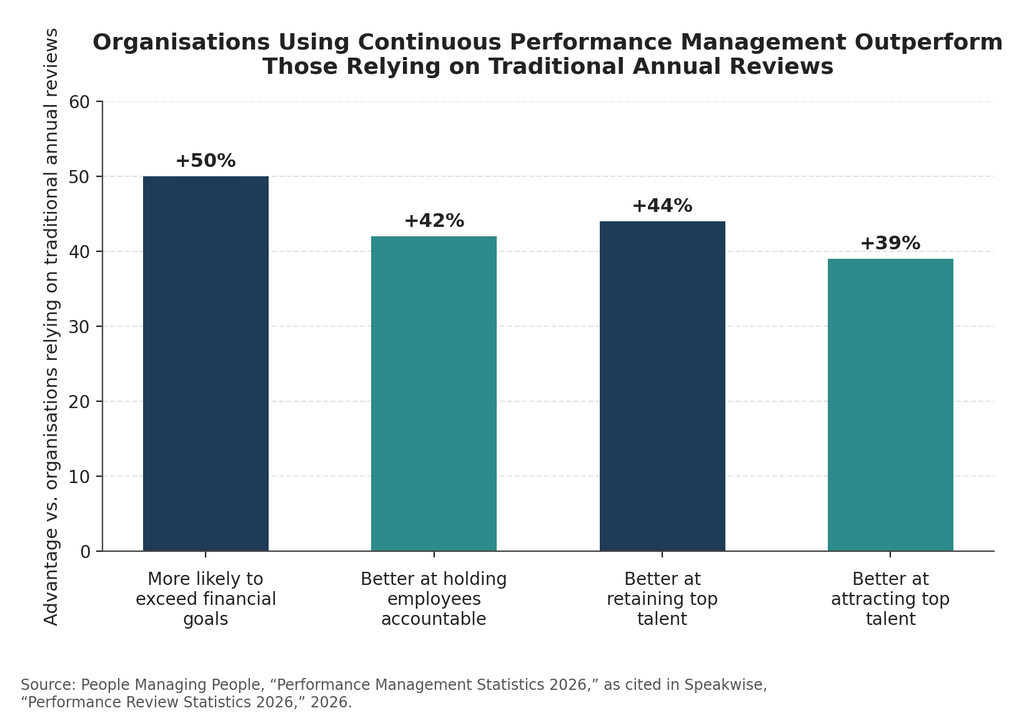
Source: People Managing People, “Performance Management Statistics 2026
Scenario Two:
The Biased Evaluation System
The organisation runs a more engaged review process; managers do spend real time on it, but the ratings that result are heavily shaped by personal opinion, recency effects, or favouritism rather than a consistent, evidence-based standard. Ratings vary widely and inconsistently across departments, and two employees with genuinely comparable performance can receive very different outcomes.
Productivity Consequences
- Loss of top talent: High-performing employees who consistently deliver strong results may become frustrated when their efforts are not recognised fairly. Over time, they may lose confidence in the organisation’s ability to reward performance and begin looking for opportunities elsewhere, resulting in the loss of valuable skills and institutional knowledge.
- Declining employee trust: When employees perceive that performance ratings depend more on personal relationships or managerial preferences than actual results, confidence in the performance management system declines. This can weaken trust in managers and leadership and reduce employees’ willingness to fully engage with organisational goals.
- Increased grievances: Perceived inconsistencies and unfair ratings can lead to more complaints, disputes and appeals. Managers and HR teams may spend significant time addressing disagreements over ratings rather than focusing on performance improvement and business priorities.
- Higher recruitment costs: As dissatisfaction grows and high-performing employees leave, organisations may need to spend more on recruitment, onboarding and training to replace them. Frequent turnover can also increase pressure on existing employees, disrupt team productivity and create additional costs that could have been avoided through a fairer and more consistent evaluation process.
Strategic Intervention Plan
- Standardising evaluation criteria across departments and business units, so that ratings are anchored to a shared definition of performance rather than to individual manager judgement.
- Regularly auditing performance ratings for consistency and potential bias, including by demographic group, helps catch systemic patterns before they harden into culture.
Source: Harvard Business Review research on the halo effect,2026
Scenario Three:
Performance Management as a Strategic Advantage
The organisation redesigns performance management as a continuous, development-focused process supported by data, coaching, and regular feedback, rather than a once-a-year rating exercise. The formal review, where it still exists, becomes a checkpoint that summarises an ongoing conversation, rather than the only moment that conversation happens.
Productivity Consequences
- Employee engagement strengthens: Regular feedback, meaningful performance conversations, and clear development opportunities help employees understand how their work contributes to organisational goals. This can increase motivation, accountability, and commitment to performance.
- Succession planning improves: Continuous performance and development data give managers better visibility into employees’ capabilities, potential, and readiness for greater responsibility. This makes it easier to identify and prepare suitable internal candidates for critical roles.
- Retention of high performers improves: When strong performers receive regular recognition, constructive feedback, and opportunities to develop their skills and careers, they are more likely to feel valued and see a future within the organisation. This can reduce the risk of losing critical talent to competitors.
Strategic Intervention Plan
- Organisations should embed continuous feedback into everyday management rather than relying solely on formal annual reviews. Managers should have regular conversations with employees about performance, progress, challenges, and development needs, creating opportunities to address issues before they become significant performance problems.
- Individual objectives should also be clearly connected to broader business priorities. Employees should understand what is expected of them, how their objectives contribute to organisational goals, and how their performance will be assessed. This creates stronger alignment between individual effort and business performance.
- Performance data should be connected to talent development initiatives so that evaluation outcomes directly inform coaching, mentoring, training, career development, succession planning, and internal mobility decisions. This allows organisations to move beyond simply measuring performance to actively developing the capabilities they need for future growth.
Conclusion
Performance reviews should be more than an annual administrative event; they should function as a strategic tool that enables continuous improvement, informed decision-making, and sustainable organisational performance. Organisations that move beyond traditional appraisal systems and embrace data-driven, development-focused performance management will be better positioned to enhance productivity, retain talent, and build resilient workforces capable of adapting to an increasingly dynamic business environment.
Partner with Us
At Proten International, we help organisations design and implement performance management systems that align individual performance with business objectives, identify capability gaps, strengthen succession planning, and improve workforce productivity. Contact us today to get started on building a performance management framework that fuels organisational goals.