In enterprise organisations, payroll is not an administrative task. It is a strategic function with direct consequences for compliance, workforce trust, and financial accuracy.
A single payroll error affecting hundreds of employees can trigger audit exposure, damage staff morale, and divert senior HR and finance talent from high-priority work. In Nigeria’s corporate landscape, where NRS, PAYE, pension contributions, and NHF obligations intersect with multi-state operations, the stakes are even higher.
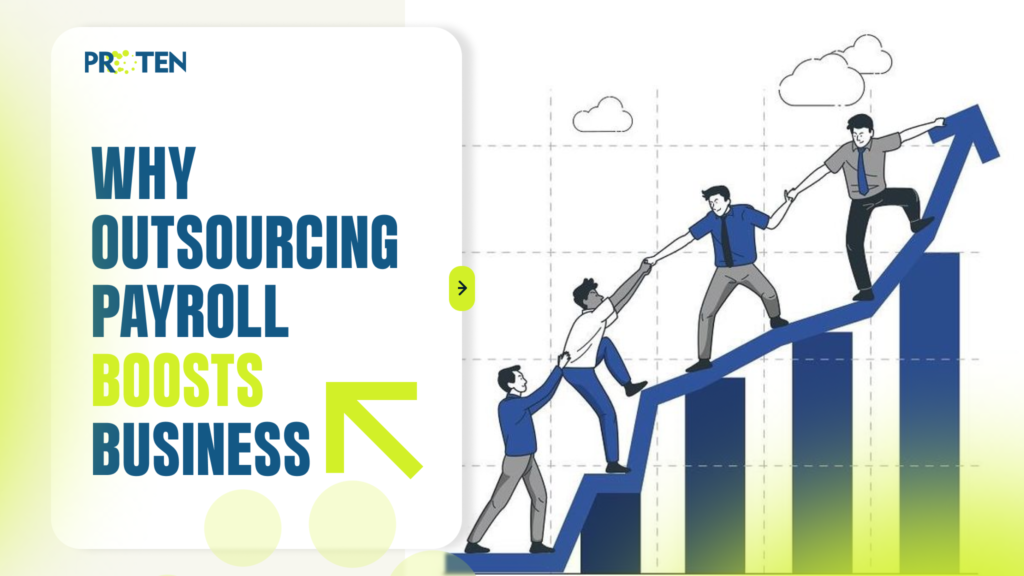
Payroll outsourcing has emerged as a performance-driven solution for large enterprises seeking to eliminate execution risk while gaining strategic capacity. This is not about cutting costs. It is about redirecting organisational energy where it creates the most value.
What Is Payroll Outsourcing?

Payroll outsourcing is the transfer of end-to-end payroll management responsibilities to a specialist third-party provider. In practice, this covers salary disbursement, tax remittance, statutory compliance reporting, payslip generation, and workforce analytics. All executed under defined service level agreements.
For Nigerian enterprises, the scope extends beyond basic salary processing. A qualified outsourced payroll services provider manages PAYE filings across multiple states, pension deductions to licensed PFAs, NHF remittances, and FIRS compliance functions that require continuous regulatory expertise to execute accurately.
Sectors with complex workforce structures like telecoms, oil and gas, financial services, and FMCG particularly benefit from outsourced payroll services that can handle diverse employee categories, allowances, and benefits at scale.
The Hidden Cost of Managing Payroll In-House

Most organisations underestimate the true cost of in-house payroll processing. Beyond direct personnel costs, the real burden lies in the opportunity cost of skilled HR and finance professionals spending three to five working days per month on repetitive payroll cycles instead of strategic initiatives.
- 40% of businesses report payroll errors in large workforce environments
- 3–5 working days are lost monthly to in-house payroll cycles
- 30% higher compliance penalty exposure without specialist oversight
Large workforces, common in manufacturing, telecoms, and oil and gas, amplify error risk exponentially. A miscalculation in one payroll component, such as an incorrectly applied tax band or a missed pension rate adjustment, can cascade across thousands of records and require costly rework that disrupts finance timelines.
Compliance exposure is equally significant. Nigerian enterprises operating across multiple states face a patchwork of PAYE obligations, each with distinct deadlines and calculation rules. Without specialist payroll management, organisations risk penalties, audit complications, and regulatory scrutiny that senior leadership should never need to manage reactively.
Finally, in-house payroll rarely produces the structured analytics that corporate decision-makers need. Workforce cost data is often fragmented, delayed, or inaccessible in a format useful for budgeting and forecasting.
How Payroll Outsourcing Improves Business Performance

Operational Efficiency
When payroll outsourcing removes the execution burden from HR and finance teams, those teams recover significant bandwidth. A senior compensation and benefits manager who previously spent three weeks per quarter reconciling payroll data can instead focus on talent retention strategy, compensation benchmarking, or workforce planning work with a measurable impact on organisational performance.
In a manufacturing or FMCG company with 3,000+ employees across five states, this shift translates directly to reduced headcount on administrative payroll functions and a reallocation of senior capability to higher-value roles.
Accuracy and Reliability
Specialist providers build their entire operational model around error elimination. Multi-location payroll processing with varying allowances, shift differentials, bonuses, and statutory deductions by employee category is handled through validated workflows and quality controls that in-house teams cannot easily replicate.
Compliance Confidence
Regulatory compliance is one of the most compelling arguments for payroll outsourcing in Nigeria. FIRS updates, pension fund administration requirements, and state-level PAYE deadlines change regularly. A specialist payroll partner monitors these changes continuously and adjusts processing protocols in real time, significantly reducing an organisation’s compliance risk exposure.
For financial services and oil and gas companies operating under heightened regulatory scrutiny, this compliance infrastructure is not optional but is a risk management necessity.
Financial Control and Analytics
Leading outsourced payroll services providers deliver structured dashboards and reporting tools that integrate with ERP and HRIS platforms. This gives CFOs and finance directors access to real-time workforce cost data, segmented by department, location, employment type, and compensation component, that supports accurate budgeting, scenario modelling, and board-level reporting.
Scalability
Organisations in growth mode, through acquisitions, market expansion, or rapid headcount increases, require payroll infrastructure that scales without service disruption. An outsourced model absorbs workforce growth cleanly, whether an FMCG company is onboarding 500 new distributors or an oil and gas firm is scaling operations into a new state or country.
Read More: HR Insourcing vs HR Outsourcing: What’s Best for Your Business?
When Should a Business Consider Outsourcing Payroll?
There are clear operational signals that indicate an enterprise has outgrown its in-house payroll capability. These include recurring payroll errors or compliance incidents, HR and finance teams consistently consumed by execution rather than strategy, and workforce expansion into new states or international markets.
Organisations should also consider payroll outsourcing when they require audit-ready records and advanced analytics that current internal processes cannot reliably produce or when their payroll complexity, due to varied employee structures, bonuses, and allowances, has reached a scale that demands specialist expertise. If your payroll management function is a constraint on strategic capacity, it is ready to be outsourced.


What to Look for in a Payroll Outsourcing Partner
Selecting the right partner is as consequential as the decision to outsource. For Nigerian enterprises, the evaluation criteria should be rigorous. Look for demonstrated expertise in Nigerian tax and labour regulations, including multi-state PAYE, pension, NHF, and FIRS compliance, with a verifiable track record across large-scale corporate clients.
Process clarity matters as much as technical capability. A credible partner will define ownership of every payroll cycle stage, establish clear SLAs, and operate with enterprise-grade data security standards. Integration capability with SAP, Oracle, or your existing HRIS is non-negotiable for seamless financial reporting. Finally, ensure the provider has direct experience managing complex payroll structures, including executive compensation, performance bonuses, and field allowances.
Payroll as a Performance Lever
The organisations that treat payroll as a performance lever rather than an administrative burden consistently demonstrate stronger compliance records, lower operational costs in HR and finance, and more strategic deployment of senior talent. Payroll sits at the intersection of HR, finance, and compliance. Managing it poorly creates risk across all three.
Structured payroll outsourcing removes that risk while generating tangible returns: reduced error rates, real-time financial visibility, regulatory confidence, and an HR function freed to lead where it matters most. For enterprises competing in Nigeria’s most demanding sectors, this is not a support function decision. It is a corporate performance strategy.
Ready to evaluate your payroll maturity? Speak with a Proten expert to explore a tailored outsourcing model designed for your organisation’s scale and complexity.