At Proten, we have seen businesses respond to employee turnover by increasing salaries, adding benefits, or launching engagement initiatives without first understanding what is driving people to leave.
That can lead to expensive solutions that do not address the real problem.
In this guide, we’ll show you how an employee retention audit can help you identify why employees leave, spot retention risks, and determine what needs to change.
What Is an Employee Retention Audit?

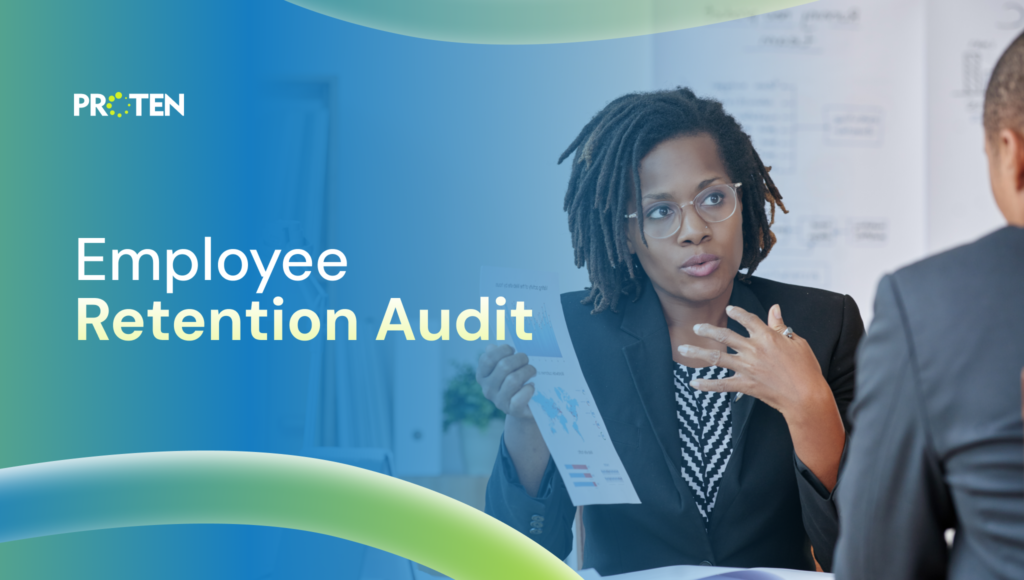
An employee retention audit is a structured review of the factors affecting employee turnover and retention within an organisation.
It goes beyond asking employees why they resigned. A useful audit looks at workforce data, employee feedback, management practices, career growth, compensation, workload, and HR processes.
From our experience, this wider view matters because the reason stated in a resignation letter may only tell part of the story.
Download our HR Audit Checklist here
How to Calculate Your Employee Retention Rate

Before investigating why employees leave, it helps to know your current retention rate.
The basic formula is:
Employee Retention Rate = ((Number of employees at the end of the period − Number of employees who joined during the period) ÷ Number of employees at the start of the period) × 100
For example, if your organisation had 100 employees at the start of the year, 15 new employees joined during the year, and 90 employees remained at the end, your calculation would be:
(90 − 15) ÷ 100 × 100 = 75%
Your employee retention rate for the year would therefore be 75%.
This number gives you a starting point, but it should not be viewed in isolation. We recommend looking at retention alongside turnover by department, role, tenure, and employee performance. A 75% overall retention rate can tell a different story if most of the employees who left were high performers or held critical roles.
You can also calculate retention for a specific group or period. For example, you could measure the retention of employees who joined within the last 12 months or employees in a particular department.
“The goal is not simply to get a higher percentage. It is to understand what the number is telling you about your workforce.”
Why Are Your Employees Leaving?

One resignation can be explained by personal circumstances. A pattern of resignations usually tells you something about the organisation.
Start by looking for patterns in your workforce data.
Check:
- Which departments have the highest turnover?
- Which roles are hardest to retain?
- How long do employees stay before leaving?
- Are high performers leaving?
- Are new hires leaving within their first year?
- Are people leaving because of managers, pay, workload, career growth, or something else?
Research from SHRM points to compensation, career development, flexibility, and leadership among the factors linked to employee turnover. SHRM also recommends that organisations identify the specific reasons employees are leaving rather than assuming the cause.
We take the same approach. We do not recommend a retention solution based on assumptions. We start by understanding what is happening in the workforce.
What to Examine During an Employee Retention Audit

1. Analyse Your Turnover Data
Start with the numbers.
Look at your overall turnover rate, voluntary turnover, turnover by department and role, employee tenure at exit, new-hire turnover, and the number of high-performing employees who have left.
From our experience, the overall turnover rate can hide the real problem. A business may have an acceptable turnover rate while losing people from the roles it can least afford to lose.
2. Review Employee Feedback
Exit interviews are useful, but they should not be your only source of information.
Review exit interviews, engagement surveys, pulse surveys, employee complaints, and other feedback. Look for repeated themes rather than treating every resignation as an isolated case.
If employees across different teams keep raising the same concern, it deserves attention.
3. Assess Managers and Leadership
Employees experience much of the organisation through their direct manager.
Look at how managers communicate, give feedback, allocate work, recognise performance, handle conflict, and discuss career development with their teams.
Gallup research has consistently linked managers with employee engagement and retention. Gallup also recommends that managers have regular conversations with employees, listen to their concerns, and recognise good work rather than waiting for formal review periods.
At Proten, we pay close attention to management capability when looking at retention. A strong retention strategy can struggle if employees are still having a poor day-to-day experience with their managers.
4. Review Career Growth and Development
Employees need to see where their career can go.
Look at promotion patterns, learning opportunities, internal mobility, succession planning, and the quality of career conversations between managers and employees.
This is worth examining closely. SHRM’s 2025 reporting on turnover found that career development and advancement remained a major reason employees leave.
Ask yourself whether employees can see a future in the organisation or whether they have to leave to grow.
5. Assess Pay and Benefits
Compensation matters, but it should not automatically become the first answer to every retention problem.
Review salary structures, benefits, incentives, pay equity, and how your compensation compares with the market.
SHRM research has identified inadequate compensation as a leading reason for turnover, while also pointing to career development and workplace flexibility as important factors.
The goal is to understand whether pay is the problem, part of the problem, or being blamed for a different problem.
6. Review Workload and Job Design
Look at whether employees have realistic workloads, clear responsibilities, adequate resources, and processes that allow them to do their jobs properly.
Repeated overtime, unclear roles, understaffing, and poor processes can create frustration that eventually shows up as turnover.
From our experience, retention problems sometimes start with how work is structured rather than with the employees themselves.


Identify Your Highest Retention Risks
Not every employee or role presents the same business risk.
A retention audit should help you identify the people and roles that would be hardest to replace or most costly to lose.
Pay particular attention to critical roles, high performers, employees with scarce skills, difficult-to-replace positions, and teams experiencing repeated turnover.
Recognition is another area worth examining. Gallup and Workhuman found that employees who received high-quality recognition were 45% less likely to have left their organisation two years later.
The goal is to move from “people are leaving” to “these are the areas where our business is most exposed.”
What Should You Do After the Retention Audit?
An audit is only useful if it leads to action.
Once you understand the findings, prioritise them based on business impact, urgency, and risk.
If managers are struggling with people management, manager development may be needed. If employees cannot see career progression, the organisation may need a stronger development or internal mobility framework.
If workload is driving turnover, workforce planning or role design may need to be reviewed. If compensation is a major issue, the business may need to reassess its pay and benefits structure.
The right response depends on what the audit reveals.
When Should You Bring in External HR Support?

Internal HR teams can often manage individual retention issues. External support can be useful when the problem is broader or when the organisation needs an independent view.
You may benefit from external HR support when:
- Turnover continues despite internal interventions
- High performers are leaving
- Several teams are experiencing repeated turnover
- HR does not have the capacity to conduct a full workforce review
- Leadership needs an objective assessment
- The organisation is growing or restructuring
- Critical skills are becoming difficult to retain
At Proten, we often see the value of an external perspective when businesses have become too close to the problem to see the pattern clearly.
How Proten Can Help With Employee Retention
At Proten, we approach retention as a workforce issue, not simply an employee engagement issue.
Our HR advisory services can help businesses assess their workforce, review HR processes, examine organisational structure and role clarity, identify workforce risks, and develop practical interventions based on the findings.
We can also support areas such as manager development, workforce planning, employee engagement, and organisational design where these are contributing to retention challenges.
The starting point is understanding what is happening in your workforce. From there, we can help you determine what needs to change and how to put the right actions in place.
If employee turnover is becoming a problem, talk to our experts about building a retention strategy based on your workforce data. Book a consultation here.