A performance evaluation should be more than a regular exercise where employees receive ratings and managers complete forms. When properly designed, performance evaluation can become one of an organisation’s most valuable tools for developing its people. It can show what employees are doing well, where they are struggling, what skills they need to develop, and who may be ready for greater responsibility.
Source: SHRM “Performance management Statistics for 2026”
However, many organisations stop at measuring performance. They identify that an employee is performing below expectations but do not always ask the more important question: What does this employee need to perform better?
This is where talent development comes in.
By connecting performance evaluation with learning, coaching, mentoring, career development and succession planning, organisations can turn performance data into meaningful action. Instead of simply identifying performance gaps, they can use those insights to build stronger employees, prepare future leaders and create a workforce that is better equipped to meet changing business needs.
The goal is therefore not simply to evaluate employees, but to create a continuous cycle:
Evaluate → Identify → Develop → Apply → Re-evaluate
When this cycle is properly managed, performance management becomes a driver of employee growth and organisational performance rather than an administrative HR process.
Why Performance Evaluation and Talent Development Should Work Together
Performance evaluation tells an organisation where an employee is today. Talent development focuses on where that employee can go next and what it will take to get there. When these two processes operate separately, organisations often miss valuable opportunities.
An employee may receive a low performance rating without being given the training, coaching or resources required to improve. Similarly, a high-performing employee may continue delivering strong results without receiving opportunities to develop the capabilities required for future leadership.
An integrated approach changes this.
Performance evaluations can provide valuable evidence for identifying skills that need improvement and employees who require additional support, while also highlighting high-performing and high-potential employees. They can help organisations identify leadership development opportunities, determine training and upskilling priorities, understand employees’ career development needs, assess readiness for greater responsibility, and identify suitable candidates for succession planning.
This allows organisations to move from evaluating performance to actively developing performance.
Strategic Framework for Integration
Integrating performance evaluation with talent development does not require creating another complicated HR system. It requires organisations to connect the information they already collect with deliberate development actions.
Stage 1: Align Performance Evaluation with Organisational Competencies
The first step is to establish a clear understanding of what good performance looks like. Performance should not be measured only by whether an employee achieves a target. Organisations should also consider the capabilities and behaviours required to achieve sustainable results.
Depending on the role, these competencies may include technical knowledge, communication, leadership, problem-solving, innovation, collaboration, adaptability, customer orientation, decision-making, and learning agility.
These competencies should be clearly reflected in job expectations, performance indicators and evaluation criteria. When performance evaluation and competency frameworks speak the same language, it becomes much easier to identify exactly what an employee needs to develop.
Stage 2: Move from Ratings to Meaningful Performance Conversations
A performance score on its own tells only part of the story. Instead of treating the evaluation as the end of the performance management process, organisations should use it as the starting point for a meaningful conversation between managers and employees.
Managers should use performance conversations to discuss what the employee has achieved, what went well, where performance fell short, and the reasons behind any identified gaps. The conversation should also explore the support required, the skills the employee needs to develop, and what they hope to achieve in the next stage of their career.
This changes the tone of performance management from “How did you perform?” to “How can we help you perform better?”
Stage 3: Diagnose Capability and Development Needs
Not every performance problem requires training. An employee may be underperforming due to unclear expectations, inadequate resources, poor management, workload pressures, process problems or a lack of skills.
Organisations should therefore identify the underlying cause before deciding on a development intervention. The objective is to ensure that development activities address the actual cause of the performance gap.
Stage 4: Create Individual Development Plans
Once development needs have been identified, they should be translated into clear and practical development plans.
An Individual Development Plan (IDP) should clearly define the capability the employee needs to develop, the specific development objective, the intervention required, the person responsible for providing support, the expected timeframe, and how progress will be measured. However, development should not be limited to classroom training.
Depending on the employee’s needs and career objectives, organisations can use a combination of coaching, mentoring, job rotation, stretch assignments, peer learning, on-the-job training, formal courses, e-learning, leadership programmes, and professional certifications. In many cases, the most effective approach is to combine several of these methods to provide a more practical and well-rounded development experience.
Stage 5: Connect Development to Career Growth and Succession
Talent development becomes significantly more valuable when employees can see how their development connects to their future within the organisation. Performance evaluations can help identify employees who may be ready for expanded responsibilities, promotion, critical projects or cross-functional assignments.
However, strong current performance should not automatically translate into promotion. Organisations should also consider potential, behavioural competencies, leadership capability, learning agility and readiness for the demands of the next role. This creates a more reliable basis for succession planning and internal mobility.
Turning Performance Insights into Talent Development
When performance evaluation is properly integrated with talent development, organisations can achieve several important outcomes.
1. Identify Capability Gaps Earlier
Regular performance conversations make it easier to identify capability gaps before they become serious performance problems. Instead of waiting for an employee to fail repeatedly, managers can identify emerging issues and provide support early. This allows organisations to build capability proactively rather than constantly responding to performance problems.
2. Make Learning and Development More Relevant
One of the common challenges with corporate training is that employees sometimes attend programmes that have little connection to their actual responsibilities or development needs.
Performance data provides a stronger basis for deciding what employees should learn. Rather than asking: “What training should we organise this year?” organisations can ask: “What capabilities do our people need to perform better and prepare for the future?” This makes learning investment more targeted and relevant.
3. Develop High-Potential Employees
Performance evaluation can also help organisations identify employees who consistently demonstrate strong results and the potential to take on greater responsibilities. This creates a stronger internal talent pipeline and reduces excessive dependence on external recruitment for critical positions.
4. Strengthen Succession Planning
Succession planning is more effective when it is based on evidence rather than assumptions. Performance trends, competency assessments, development progress and manager feedback can help organisations determine whether an employee is genuinely ready for a future role. This allows organisations to identify potential successors early and deliberately prepare them for critical positions.
5. Improve Employee Engagement and Retention
Employees are more likely to remain engaged when they understand what is expected of them and can see opportunities to grow.
A performance management system that is connected to career development can communicate an important message: “Your performance matters, and we are invested in helping you become better.” This can strengthen employees’ sense of purpose, career ownership and connection to the organisation.
Targeted Development Interventions
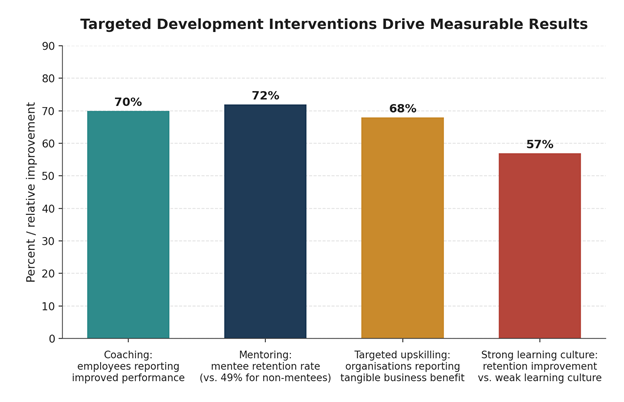
An integrated performance and talent development system should not rely on a single development solution. Different performance and capability needs require different interventions.
- Personalised Development: Employees with specific capability gaps should receive development plans that address their individual needs rather than being placed automatically on generic training programmes.
- Coaching and Mentoring: Coaching can help employees improve specific performance challenges, while mentoring can provide guidance, experience and broader career perspective.
- Leadership Development: High-performing employees with leadership potential should be given deliberate opportunities to develop the skills required to manage people, make decisions and lead strategically.
- Stretch Assignments: Employees can develop faster when they are given opportunities to apply new skills to meaningful business challenges under appropriate supervision.
- Targeted Learning and Upskilling: Formal training, digital learning and professional development should focus on clearly identified technical, behavioural and leadership capabilities.
- Career and Internal Mobility: Development plans should be connected to potential career paths, allowing employees to understand the capabilities required for future roles within the organisation.
Source: International Coach Federation
The Role of Managers
No performance and talent development system can succeed without managers actively participating in it. Managers are often the closest observers of employee performance. They therefore play a critical role in identifying development needs, providing feedback and creating opportunities for employees to apply what they learn.
Managers should be equipped to set clear performance expectations, provide regular feedback, conduct meaningful performance conversations, identify capability gaps, develop individual development plans, coach and support employees, recognise improvement, identify high-potential talent, and support employees in their career development. This means organisations should also invest in developing managers as effective people leaders. Proten International’s training, HR for Non HR Managers, could prove very useful in this regard.
Conclusion
Performance evaluation should not be the point at which organisations simply tell employees how well they have performed. It should be the starting point for deciding how they can become better.
When performance evaluation is connected to talent development, organisations gain a clearer understanding of their people’s strengths, development needs and future potential. Employees receive more relevant support, managers become better equipped to develop their teams, and organisations build stronger pipelines of capable talent.
Ultimately, the objective is simple: measure performance, understand what drives it, develop the capabilities that matter, and continuously prepare people for what comes next.
Partner with Us
At Proten International, we help organisations design and implement performance management and talent development systems that connect employee performance with organisational growth.
From performance frameworks and competency models to learning and development programmes, leadership development and succession planning, we help organisations build systems that turn employee potential into measurable business performance. Contact Us today to learn more.